How much to drink?
I sweat a lot.
That’s not exactly groundbreaking (or useful) information. How much is a lot? How much should I replace? What factors affect my sweat rate?
After an outdoor summer run, I am typically covered in sweat with salt visible on my skin and clothes, but I never knew how much sweat I was actually losing and how much salt was included in that sweat.
So I started collecting data to get some answers to my questions.
Time to get nerdy.
THE DATA-THERE’S A LOT OF IT!
My hydration data comes from two main sources.
The first one is a set of 24 indoor runs using the H-Drop device (a wearable that measures your sweat rate and sodium concentration). These were mostly from January using the treadmill in my basement.
Those tests established a pretty solid baseline of a sweat rate at a controlled temperature:
Average sweat rate: 33.9 oz/hour
Average sodium loss: 1,139mg/hour
Sodium Concentration: 33.6mg/oz (1,136mg/liter)
That means I am losing approximately one liter of sweat every hour under those conditions.
But then I wanted to find out what happened when I moved those runs outside.
So throughout training I started weighing myself before and after runs, recording exactly how much I drank, noting the weather including humidity, and tracking bathroom stops (bathroom stops make the numbers a bit more approximate since shockingly I didn’t measure it, but I used approximations and I think the numbers are still accurate enough)
Between the H-Drop testing and the usable scale-based training data, I now have over 40 hydration obvservations to work with.
Not every measurement is perfect, this wasn’t done in a lab…it was done in my bathroom with a scale from Amazon. Some runs involved bathroom stops. Some were four hours long and some were 30 minutes. Weather changed, snacks varied (though were measured), and so on.
Rather than hide those limitations, I wanted to throw them out there.
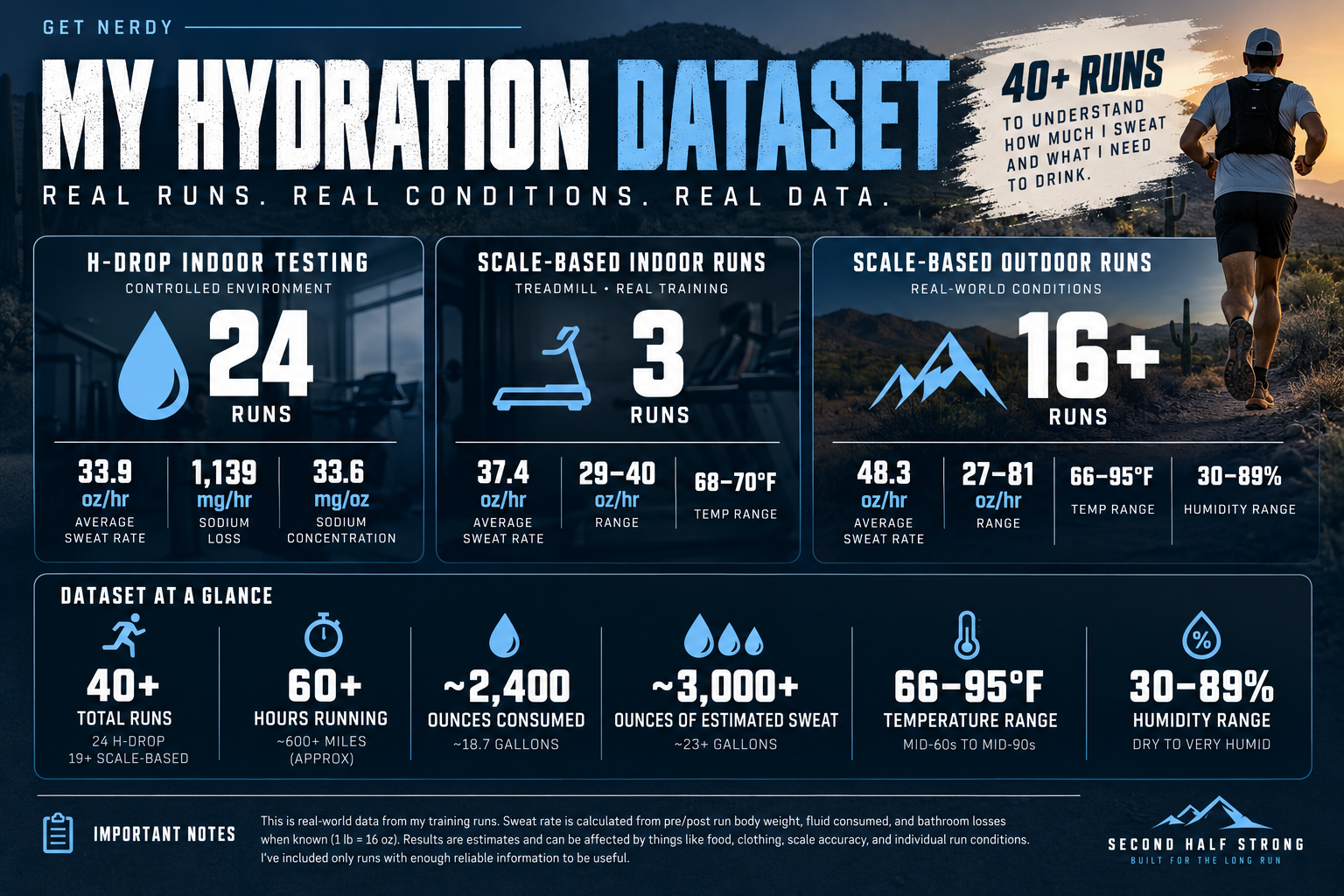
24 H-Drop runs | 40+ Total Observations | 33.9 oz/hr Baseline | 1,139 mg Sodium/hr | 66-95 degrees tested
QUESTION 1: DOES MY CHEAP SCALE METHOD EVEN WORK
This was one of the more interesting findings.
My 24-run H-Drop dataset put my average sweat rate at:
33.9 oz/hour
Then I looked at some controlled indoor runs where I used nothing more complicated than my bathroom scale and measured fluid intake.
One calculated to roughly 35/oz hour
Another was approximately 40/oz hour
That’s not a perfect match, but it’s surprisingly accurate to the H-Drop tests.
That gave me much more confidence in using the pre/post weighing as a practical way to learn my hydration needs outside.
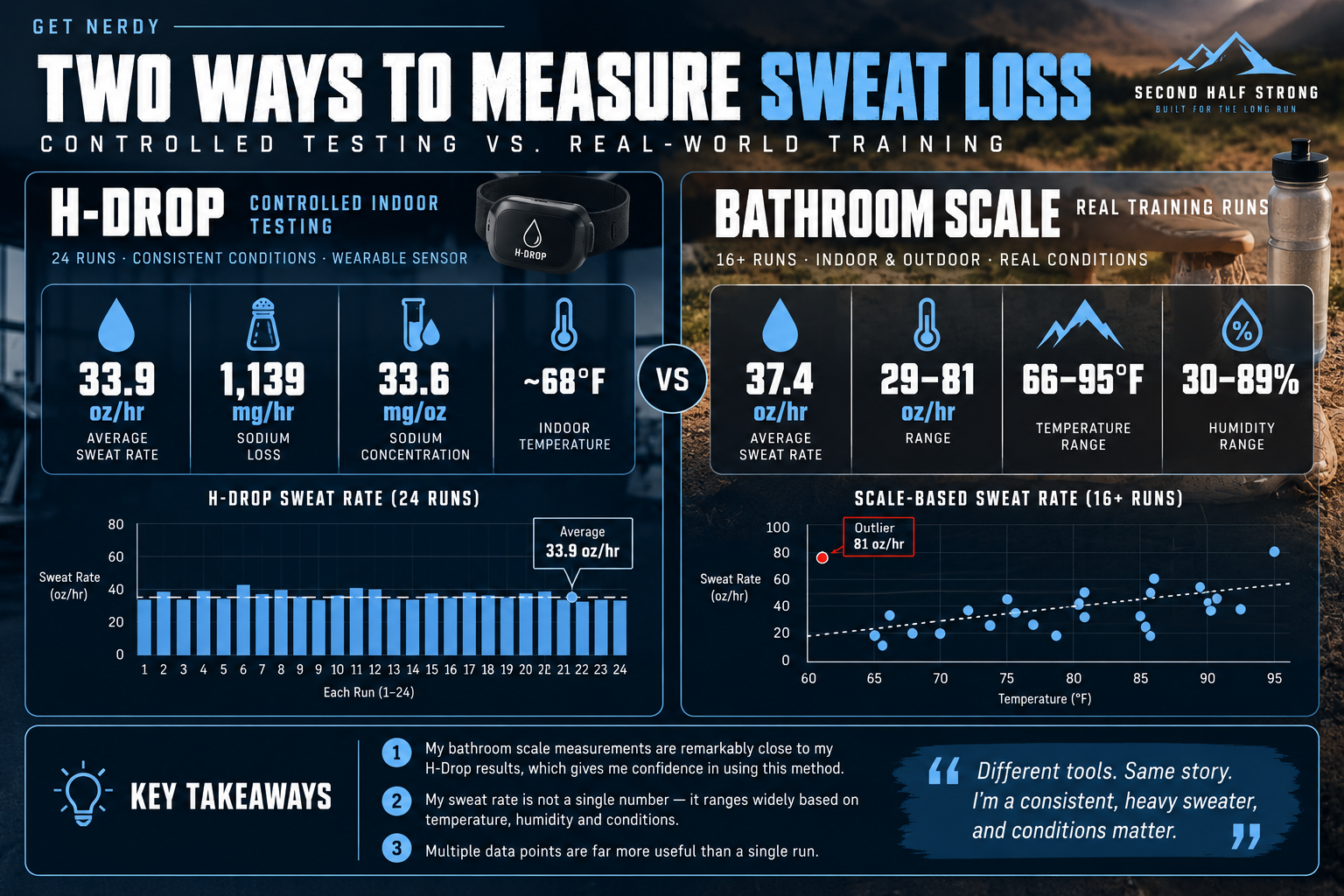
H-Drop vs Bathroom Scale
THEN I TOOK THE EXPERIMENT OUTSIDE
This is where things got interesting.
There isn’t one number that represents my exact sweat loss/hour because the conditions change.
I trained in temperatures ranging from the mid-60s to the mid-90s with humidity approaching 90%.
As the temperature and humidity changed, so did the amount of water moving through my body.
And that’s an important thing to keep in mind:
My sweat rate isn’t a constant. It’s a range.
A cool indoor run and a hot/humid outdoor run are two very different things especially when it comes to hydration.
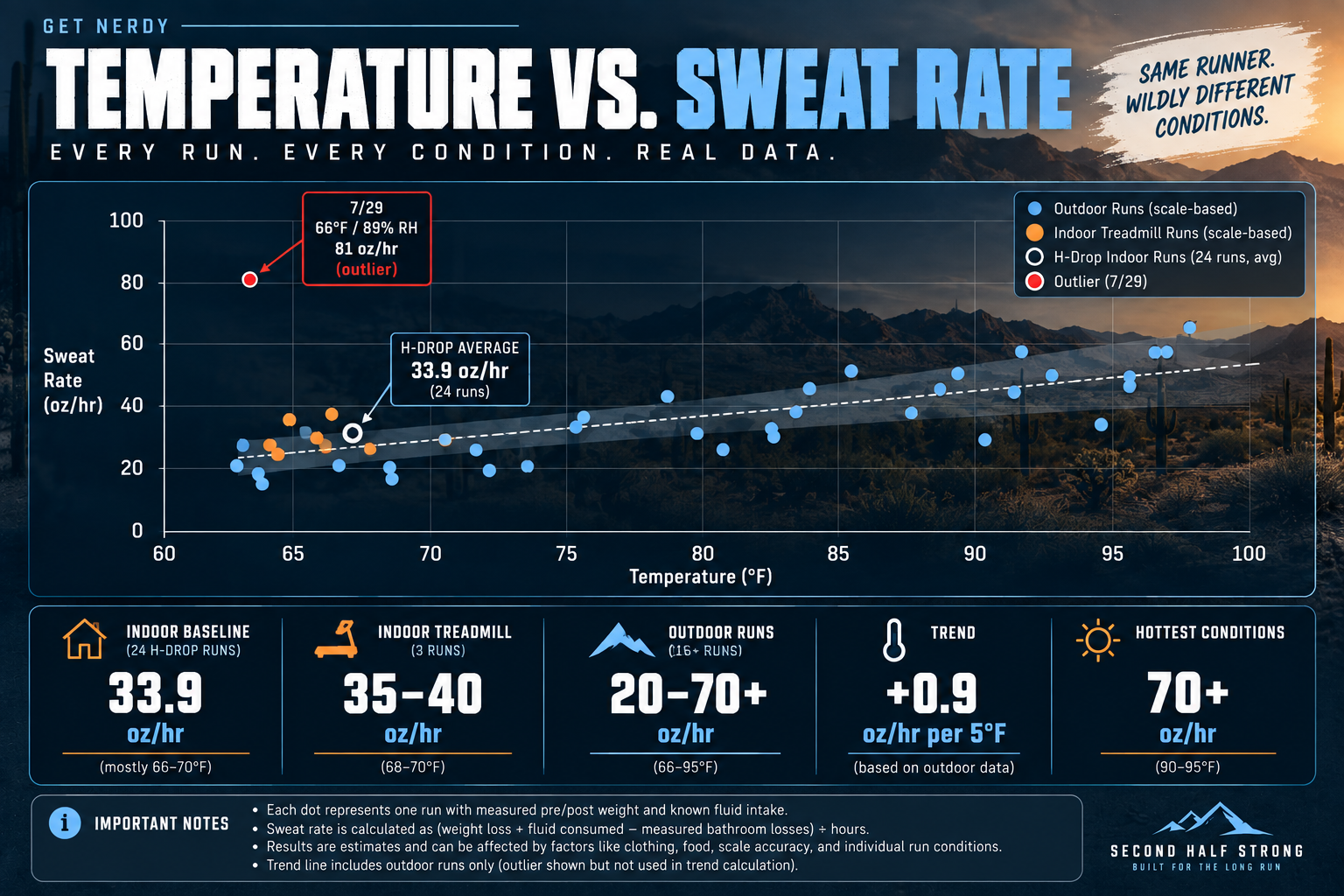
Scatter plot with temperature on the X-axis and calculated sweat rate on the Y-axis. Each dot represents on qualifying scale-based run.
THE WEIRDEST DATA POINT
What in the world happened on July 29th?
The temperature wasn’t crazy, only 66 degrees. The humidity was crazy though at 89%.
I was intentional with this run, going 45:00 without consuming any fluids because I wanted the most accurate number.
Pre-run weight: 186.6lb
Post-run weight: 182.8lb
Scale difference: 3.8 lb
60.8oz in 45:00 (approximately 16oz in a pound)
Moving that to an hour would make this 81 oz/hour lost
That’s an extremely high number compared to the rest of my data.
So what do I do with that information? I kept it. I flagged it as an outlier. But being an outlier, doesn’t mean the measurement was wrong-it’s one of the cleanest measurements I had. No water, no food/gels, no bathroom break, weigh in before and after.
So why such a big number? Maybe a small variance in my scale? Maybe the humidity really affected me? Maybe I was over hydrated to start the run and the water was pouring out of me? Maybe a combination of everything?
But I don’t think I just throw this number out because it seems “weird”. I also don’t think I change my hydration plan because of this one run.
THE SCALE CAN ALSO FOOL YOU THE OTHER WAY
One of my favorite examples came from a four-hour run in September.
Starting Weight: 187.8lbs
Finishing Weight: 186.2lbs
If I only looked at the weights on the scale, I only lost 1.6lbs over 4 hours. That’s just 25.6oz total lost.
But then you have to factor in what was consumed.
During that run, I consumed 136oz of water.
So the water moving through my body was drastically different than the weight would suggest.
Add the 25.6oz in weight loss + 136oz consumed = 161.6 total fluid loss which equals 40 ounces/hour which is perfectly in line with the numbers we have seen throughout.
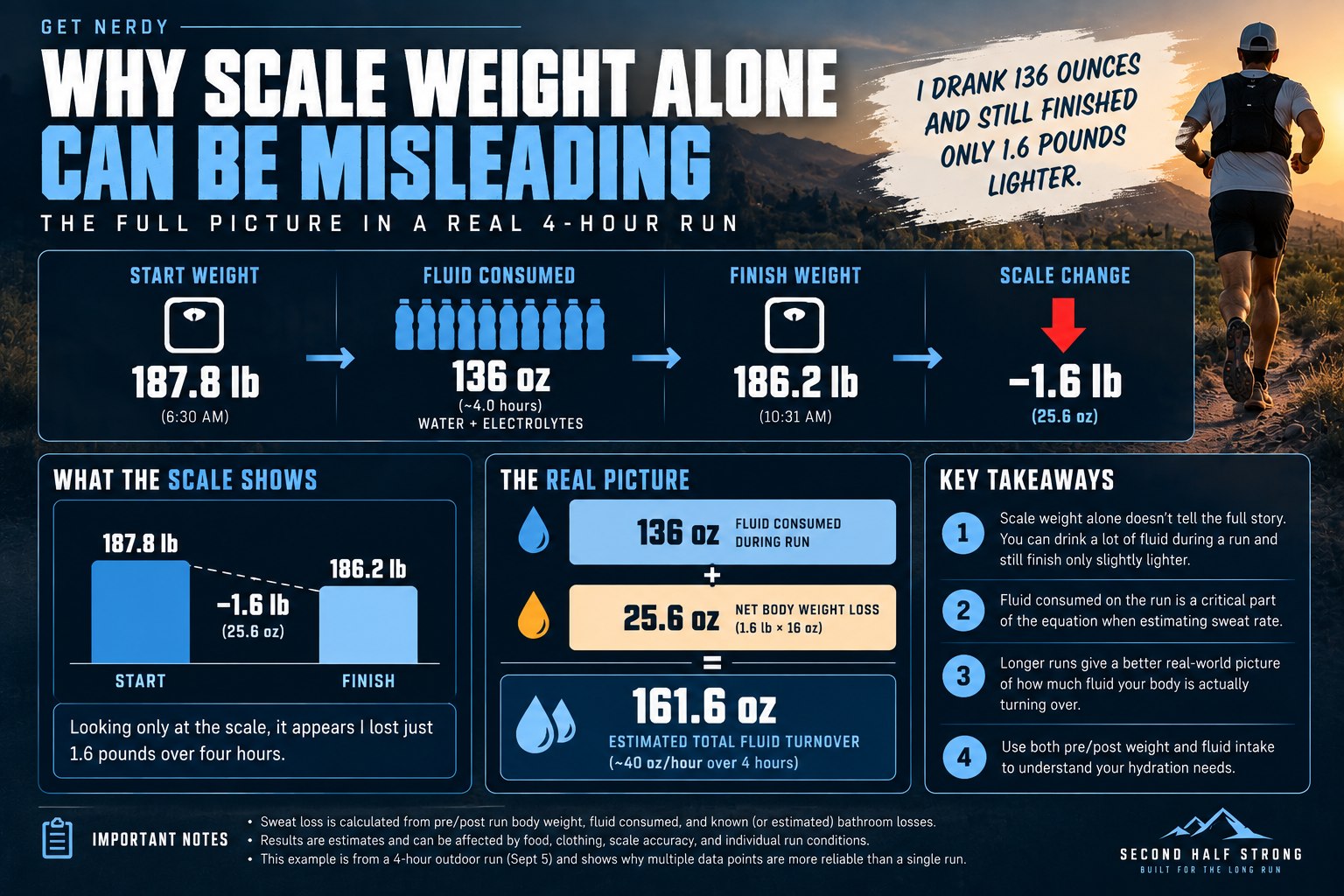
Scale weight loss + Fluid Intake is important to factor in
NOW ADD SODIUM
I am not going to go super deep into sodium because honestly it is still a number I am working on and I think I will be going to do a Precision Hydration sodium test, but I at least wanted to touch base on it here.
My measured (H-Drop) sweat contained approximately 33.6mg/sodium per ounce of sweat.
That means as my sweat rate increases so does my need for sodium.
For example, if I am losing 25oz/hour of sweat, I am “only” losing approximately 840/mg hour.
But, if that increases to 40oz/hour of sweat, now I am at 1,344/mg sodium, and to be drastic, if we got to 60oz/sweat an hour which could happen at Javelina I would be losing about 2,000mg of sodium/hour.
And it is important to remember, that is the amount of fluid and sodium that I have lost, not necessarily what I am looking to replace.
I have heard huge ranges for percentages to replace, but my plan is to start with about 750mg of sodium/liter and adjust if needed.
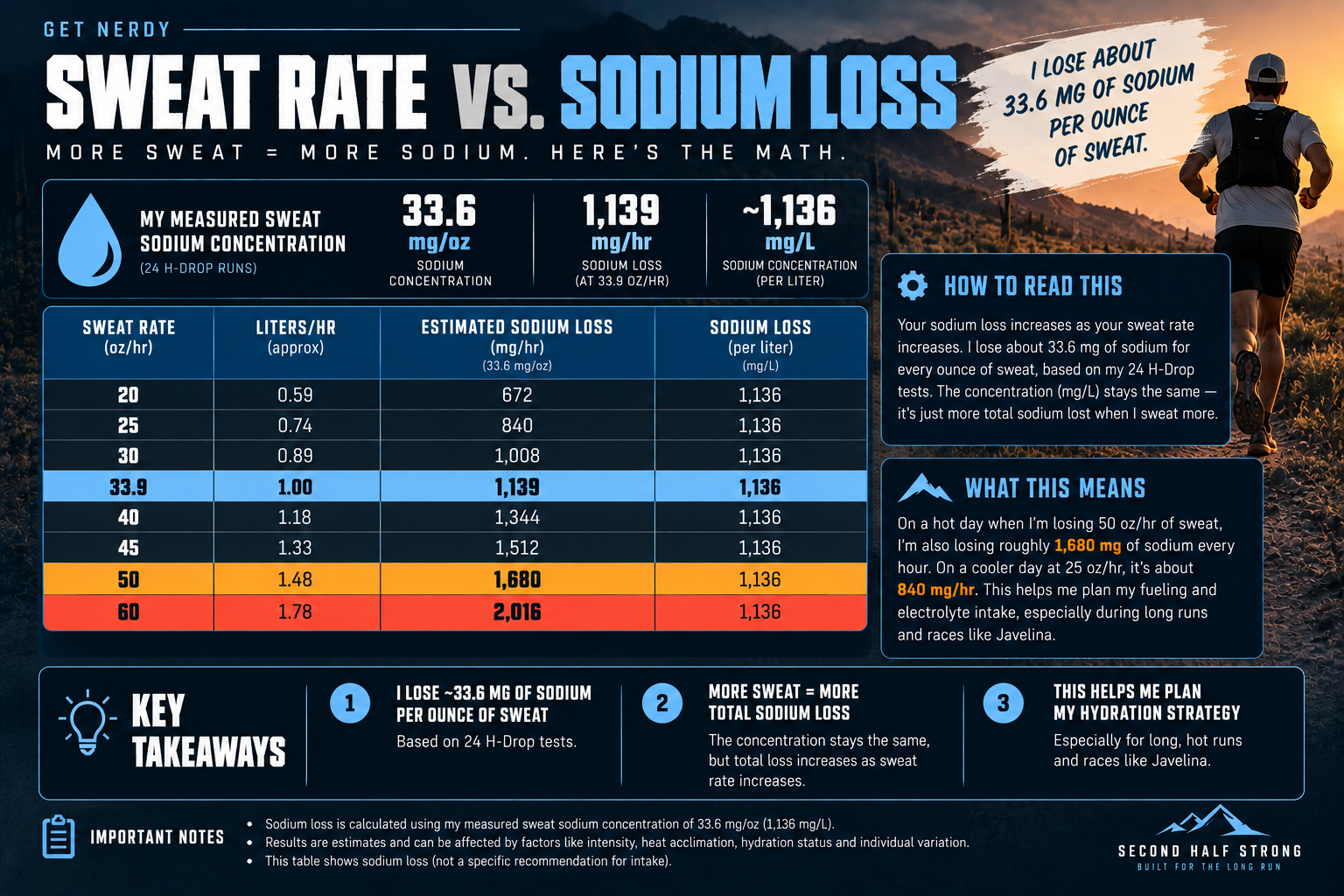
Sweat rate loss along with corresponding estimated sodium loss
LOSING 50 OUNCES DOESN’T MEAN CONSUME 50 OUNCES
This may be one of the most important things I have learned from this.
Sweat rate and drinking rate are not the same exact thing.
If I am sweating 50 ounces per hour, that doesn’t mean I have to automatically drink 50 ounces per hour (thank goodness!)
The body can tolerate some fluid deficit. Trying to replace every single ounce—especially over a very long race—can create some problems of it’s own.
Instead, knowing my sweat rate gives me some guidelines.
I can factor in things things like:
Approximately how much sweat am I losing
What are the weather conditions
How is my stomach handling the fluids + foods
How often am I urinating (rule of thumb I’ve head is once every 3 hours is good)
What color is my urine
Am I thirsty
How am I feeling
How long until the next aid station
The data helps inform the decision, it doesn’t necessarily make the whole decision.
I heard a podcast where the host said the human body is the greatest computer of all time, it will tell you when you are thirsty and when it does, drink. I think that can be accurate but also maybe a little bit over simplified.
If I only ate when I felt hungry during an ultra, I would fall WAYYYY behind on nutrition, and I think that would likely be the case with hydration.
But if you combine the data as a guideline along with what your body is telling you, you will be in the right ballpark.
SO WHAT DOES THIS MEAN FOR JAVELINA
This entire experiment was done so I could prepare for the Javelina Jundred on October 31st, 2026. Living and running in Minnesota is drastically different than the desert of Arizona so I wanted to use some data from this summer to get a feel for how my body reacts to running in the heat.
The vest I plan to use at Javelina (Salomon ADV Skin 12) carries two-500mL front flasks, so 34 total ounces.
Now the question for me is: “Is 34 ounces enough?”
Enough can be hard to determine.
If it takes me an hour to run between aid stations, I will have 34oz/fluid per hour and I think that is enough.
But what if it takes me 75 minutes? Now I am at 27z/hour and that might make me short.
What if it’s the heat of the day and according to my data I am losing somewhere around 50oz/hour at 90 degrees and I am in a segment that I won’t see an aid station for 75 minutes? Is 34 total ounces going to be enough for me?
That is where the value of this data can help me.
Knowing that I might be 75:00 away from the next aid station I might have to be strategic and make sure I drink 8-12oz of water before leaving an aid station and then another 8-12oz once I arrive at the next one.
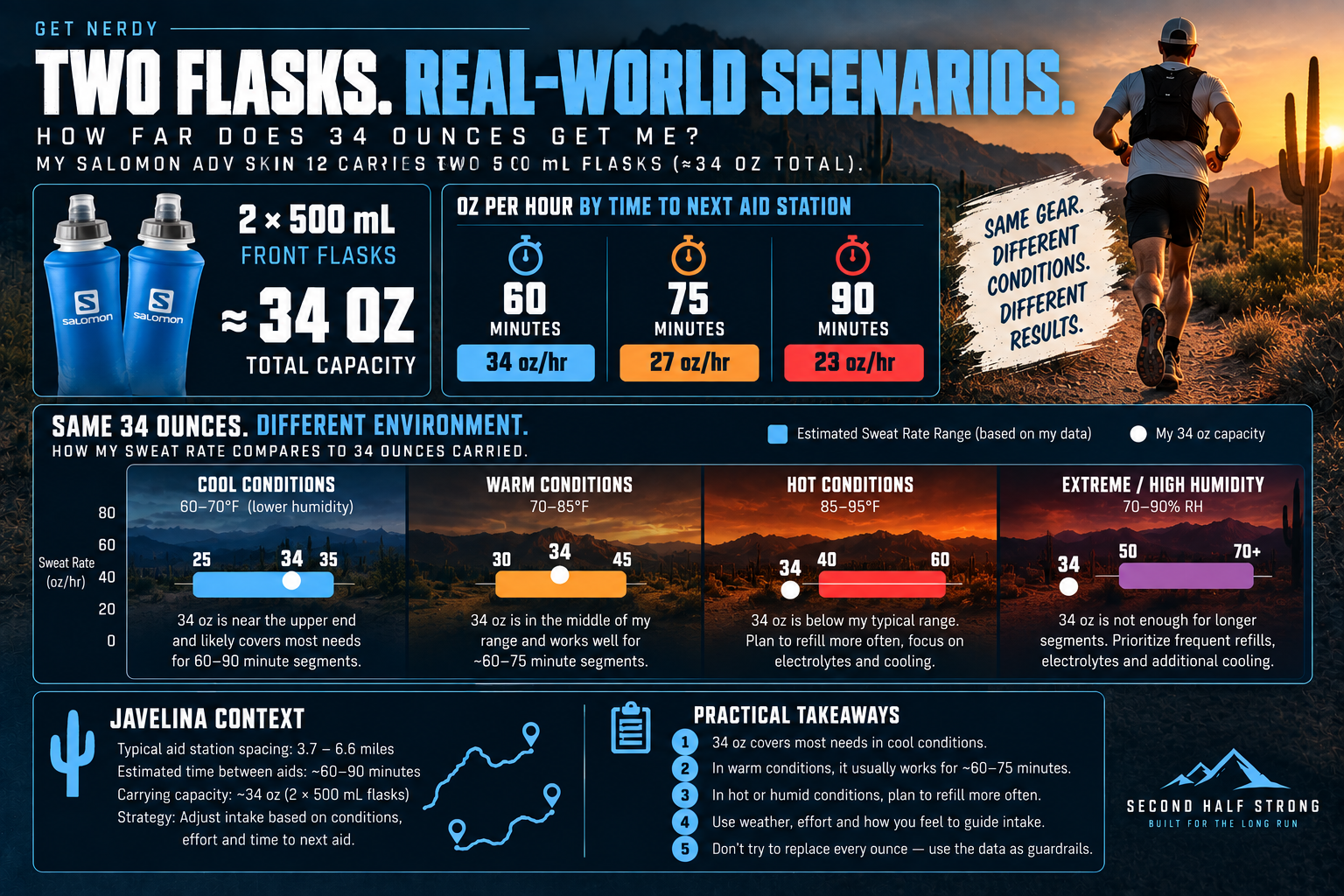
My hydration needs vary greatly depending on the conditions
SO….ENOUGH WITH THE DATE…HOW MUCH WATER DO I NEED
After all of this data, you would think that I would have a perfect number, but I don’t.
I know my baseline is around 34 ounces/hour, but that number can go up or down drastically depending on temperature as well as pace/effort.
Loop 1 hydration will look completely different than my hydration will look on loop 2 and 3 during the hottest part of the day which will again look different than loop 4-5 throughout the night and into the early morning.
To treat mid 70s temperatures the same when it comes to hydration as I treat mid 90s would be a race crippling mistake.
Adjust as conditions adjust.
WHAT I LEARNED THROUGH THIS EXPERIMENT
I started tracking this in order to know how much water, and what bottles/vest/handhelds I would be using at Javelina.
Even though the answer I came up with isn’t an easy concrete number, I do believe I got an answer. It just might be a bit more complicated and variable than I would prefer.
After 40+ measurements, I have a ton of data points, I have a fairly confident baseline, and I have a strong idea of how heat and humidity affect that baseline.
I also know approximately how much sodium I am losing per liter of fluid and how much I plan to replace and how I plan to replace it.
My goal will be around 800mg/liter of sodium through salt capsules, tablets, and drink mixes. But I am also going into it open minded and knowing that I might have to adjust that number as I go.
I know how much water I will be carrying at Javelina (34oz) and I know which aid stations I will have to be sure to leave the aid stations topped off when it comes to hydration (From Coyote to Jackass is 6.5 miles which is the longest stretch between aid).
CONTROL THE CONTROLLABLES
One of the most important things in ultras is to control the things that you can, because so many things will happen that you can’t control.
I think that is a big reason I spent so much time tracking my hydration needs. That, along with dialing in my gear and clothing, my nutrition, caffeine strategy, and crew/aid station plan are things I can control. I need to nail those things as well as I can because there are going to be a ton of things that I cannot control.
I am so excited for Javelina and feel like I am in such a better place than I was back in April when I DNF’d Zion.
Now I have to go out and prove it.