
Five loops. One hundred miles. A 30-hour success/failure line. Here is what I think is going to happen—and what I’m probably completely wrong about 8 days away from the race.
With Javelina Jundred just around the corner, I figured it would be interesting to put my entire race plan into writing. It will be interesting to see what I was correct about, what I was wrong about, and what I didn’t even consider.
I have spent months thinking about pacing, nutrition, hydration, aid stations, crew logistics, and about 1,000 other little things that might happen throughout the 100 miles.
This will be my second attempt at 100 miles. My first was Zion in Utah back in April, where I made it to mile 52 before DNF’ing. I learned a ton throughout that race, mainly that I did not want to DNF again!
Time to control the controllables.
With Cocodona 250 coming up in May, Javelina will have a major impact on my confidence.
Finishing it and proving to myself that I am capable of completing 100 miles would be a huge boost.
Not finishing 100 miles for the second time in a row would be a mental hurdle to clear before Cocodona.
No pressure!
I do feel like I am physically capable of finishing. The question is whether I can execute the plan and handle the unknowns that the desert will throw at me.
So, here we go.
THE GOAL: WHERE’S THE SUCCESS/FAILURE LINE
I’ve “created” (not sure it’s much of a creation but…) something that I call the SFL, or my Success/Failure Line. It’s a pretty straightforward concept. Before a race, I establish a clear and measurable line that separates success from failure.
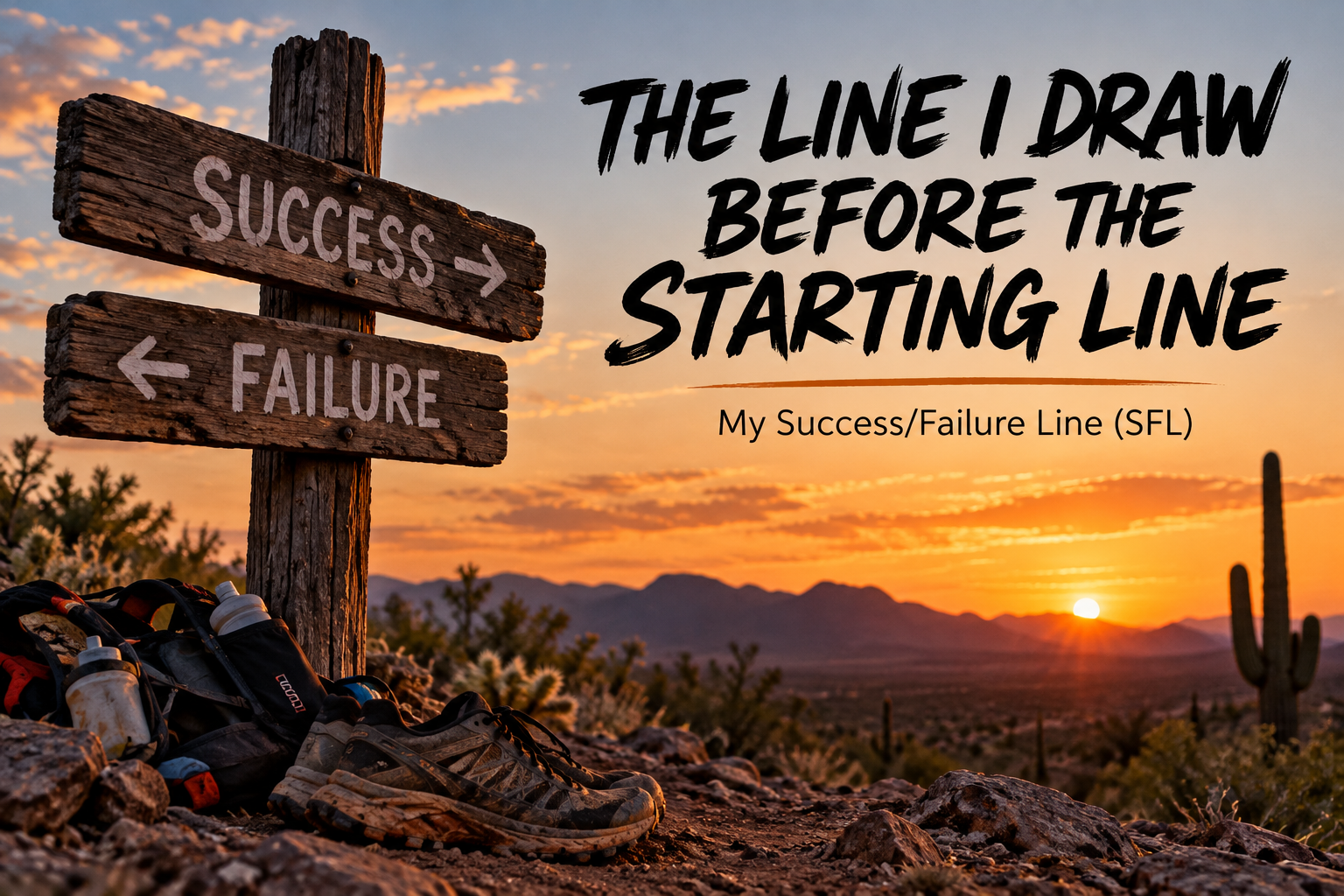
For Javelina, that line is 30 hours, which is the official race cutoff. Get my first 100 mile belt buckle.
Finish under 30 hours = Success
Unable to finish within cutoffs = Failure
I know the SFL concept isn’t for everyone, and that’s perfectly fine. Even if I “fail”, that doesn’t mean that I won’t take important lessons away from the race, but I like having a clear definition of what I am trying to accomplish before I set out.
And, just because my SFL is 30 hours, that doesn’t mean that I plan on coasting and coming across at 29:59:00.
I think I’m capable of something in the twenty-six hour range if I push myself, execute my nutrition plan, and stay efficient at aid stations.
Twenty-four hours? I think that’s probably about the best I’m capable of right now. I would have to have a really good day with very few mistakes.
The challenge with pacing is deciding how much risk I’m willing to take.
Do I start out the race shooting for that 24 hour mark? Raising the risk of bonking.
Do I start out slow and conservative knowing it increases the odds of finishing but diminishes the odds of twenty-four hours?
Somewhere in there is the sweet spot and I just have to find it.
WHAT ZION TAUGHT ME: DON’T BE AN IMMAUTRE CHILD WHEN RUNNING
My biggest mistake at Zion was taking a downhill way too fast. Sub-7:00 pace early in the race. Wasn’t even a huge downhill, but I just let the gravity of the hill take me and I was long striding, passing everyone, and thinking I was Jim Walmsly.
I, in fact, am not Jim Walmsly and I absolutely fried my quads 8 miles into the race.
I saved about thirty seconds on that hill. It ruined my entire race and then I DNF’d at mile 52 after using my poles just to keep weight off of my legs for about 30 miles. Not the risk/reward proposition you are looking for!
Looking back, if it wasn’t for the disappointment of failure, it would be comical. I was willing to risk my entire race to save a few seconds on a downhill.
Javelina doesn’t have the same kind of descents as Zion, but the lessons still apply.
I’m refusing to chase tiny time savings if they come with a huge risk.
I can find those minutes somewhere else.
THE START: A DECISION I’M SPENDING TOO MUCH TIME THINKING ABOUT
One of the things that I keep going back and forth on is how to deal with the bottleneck at the beginning of the race.
Javelina has sections of single track, and with around 500 runners in my time slot the first mile or so is going to be a conga line.
If it goes the way I think it will, I am guessing we are talking about a 5-10:00 slowdown, which isn’t a huge deal, but all of those ten minute “not huge deals” add up over 100 miles.
So I have looked at two different approaches:
Option one is to work my way towards the front of the pack before the start, and come out relatively fast. Get ahead of the congestion, skip the first aid station (I will be carrying plenty of supplies), and try to get ahead of the chaos.
Option two is accept the delay, start towards the back, and take advantage of the forced slow down at the beginning.
Both options make sense to me, and depending on what day (or hour) you ask me, I will give you a different answer on my plan.
THE FIVE LOOP PLAN
Javelina consists of five loops that are roughly 20 miles each (first loop is a bit longer, loops 2-5 are exactly the same). I’ve spent a lot of time thinking about how I want to approach each one.
Loop 1: Be Intentionally Bored
I heard this on a podcast and I love it. The first loop is basically your warm up.
I want to settle into a comfortable rhythm, get my body moving, and avoid doing anything stupid. Keep my heart rate where it should be, not exerting too much effort, and just easing my 43 year old body into what it’s going to be asked to do.
That being said, I also don’t want to get too far behind the sticks. I don’t want to fall so far behind goal paces that I am forced to make up time later in the race when the heat will be there and my legs are fatigued.
The goal is to run the vast majority of this loop (all?) while keeping the effort controlled, returning to Javelina Jeadquarters feeling great.
If I get back and I need a full reset then we are in for a long day in the desert.
Loop 2: Time to Get to Work
This is the first “get to work” loop, after the “warm up”…how crazy is it that 20+ mile loop in the desert is a warm up?
Loops 2 and 3 are going to determine what time goal is going to be on the table.
I really want to run almost all of the first 40 miles. Not at an aggressive effort or pace, but just consistently moving forward with no unneeccesary walking.
I don’t need anything spectacular with this loop, I just need it to be consistent.
I have to be intentional here and remember that we are still in the first half of the race. Take care, run maturely, and know that what I do in the first two loops will set the table for what I can do in the final three.
Loop 3: Don’t Let it Break You
This is likely the most important loop and the loop that many runners think is the hardest.
This is when the heat will be at its highest, fatigue will be settling into my legs, and I will be getting into the territory where things are unpredictable.
This is also the point of the race that I will pass the furthest I have ever run before.
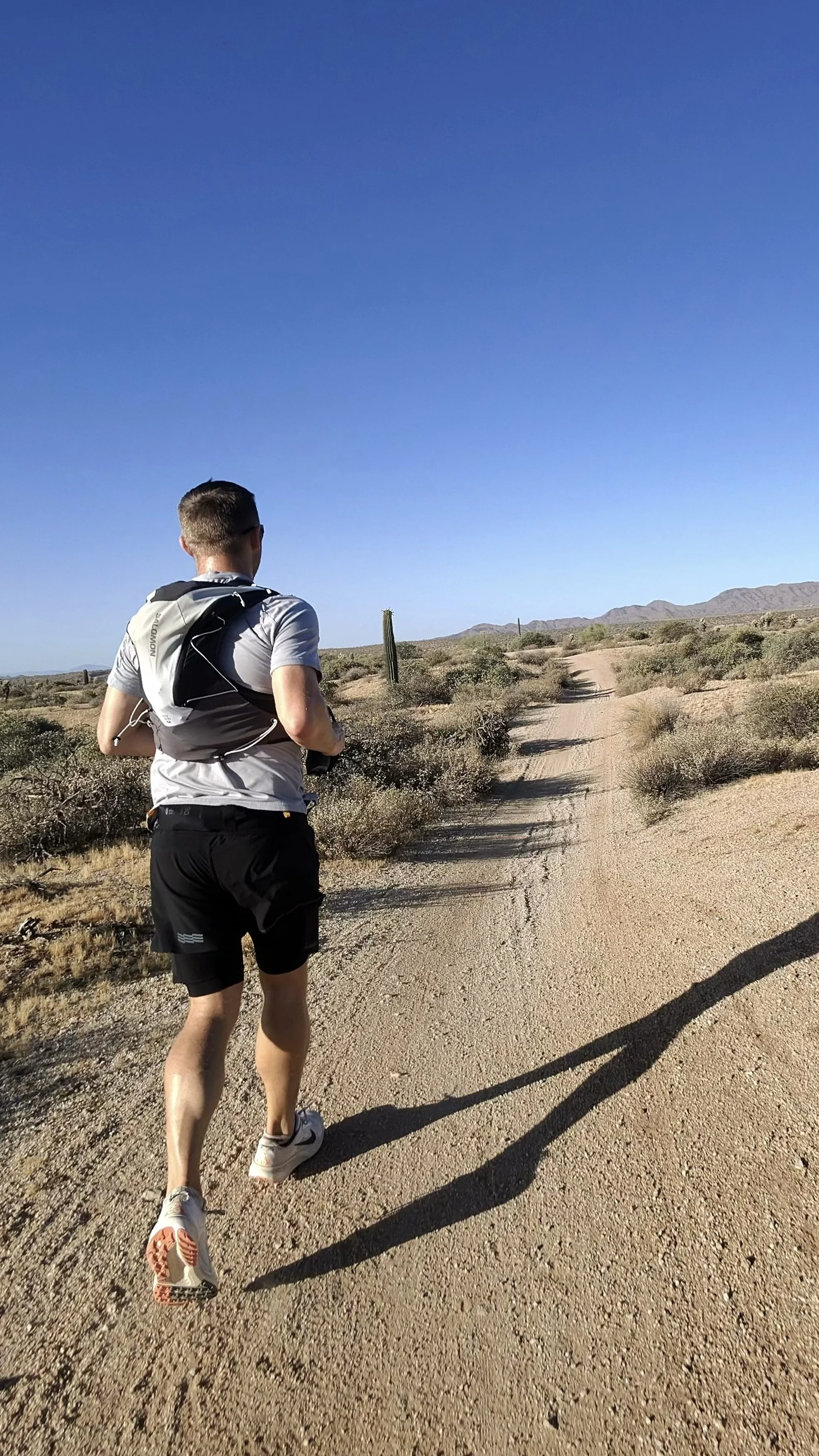
I know that I have to respect the conditions, especially coming from Minnesota, I am not used to desert conditions. And that doesn’t just mean the heat. I am not used to the dryness, the sand, and the loose rocks. I am used to grassy trails with trees and cooler temps with humidity.
So, if I need to spend a few extra minutes an an aid station to cool down, refuel property, or address an issue, I need to take that time.
Risk/Reward pendulum.
It’s also important to remember that 60 miles isn’t almost finished. There are still nearly 2 marathons left.
Don’t let loop 3 break my race.
Loop 4: Time to Make Some Decisions
This is where I expect to start evaluating my time goals more seriously.
Is 24 hours still possible? 26 hours? Am I starting to worry about the 30 hour line and the mindset shifts from racing to finishing?
How do I feel? Am I still running well? Is it time to push a bit for time or time to settle in and protect the SFL?
This is also where I might pick up the first pacer I’ve ever used, Katrina.
I’m still undecided if I will have her run loop 4 or loop 5 with me.
Loop four makes sense because we’ll likely be entering the nighttime hours, and I think this could be the loop where I need help getting over the hump.
But if I’m feeling great, I might have her wait until loop five and help push the pace all the way to the finish line.
We will make that call during the race.
Loop 5: The Celebration Loop
Once I leave Jeadquarters for the final loop, barring something going horribly wrong, I’ll be in position to finish my first 100-miler.
Granted, I will still have nearly a marathon to complete, but mentally, I think it’ll feel different.
Every aid station you pass, every landmark you run by will be the last time you go past it.
This is the loop to empty the tank, assuming it isn’t sitting bone dry already.
Heart Rate and RPE (rate of perceived exertion) still matter, but with less than 20 miles remaining, I won’t be nearly as concerned about keeping things perfectly controlled.
I want to finish the race knowing that I gave it everything that I had for that given day.
Ideally, loop five becomes a celebration of the work that it took to get there.
But ask me how celebratory I feel at mile 93!
RUNNING, WALKING, AND AVOIDING THE DEATH MARCH
My walking strategy is primarily terrain-based.
Walk the hills if needed. Run the flats and downhills whenever possible.
I do want to avoid the trap of walking when I don’t need to. The more you walk the easier it becomes to continue walking so that is something to avoid.
And walking versus running adds up to an enormous amount of time over 100 miles.
If fatigue forces me into a run/walk strategy I will likely go to a “walk a song/run a song” on my headphones. I have done this in the past instead of a more traditional run/walk ratio based on time.
But there are a couple of rules to that. If it’s a run song but there is an uphill I will walk it and if there’s s a walk song and I come to a downhill I will run it.
Also, the walking needs to be intentional. Walking isn’t going out for a casual stroll through the desert, it is working towards the finish line. I want my walking pace to be in the 15-18:00/mile range.
NUTRITION: EAT THE DAMN GEL
Get the big number out of the way right away, I am hoping to consume 75 carbs/hour.
This is one of the areas that I feel most confident in at this point.
My primary source of carbs will be Precision 90 gels and I will be bringing 3 gels plus a Precision Chew along with me for every loop, totaling 300 carbs. I will also take some real food at aid stations, so assuming 4-5 hour loops I should be right around that 75 carbs/hour.
I also have some backup options such as Tailwind drink mix, candy, and Bobos bars.
I know somewhere along the way, the nutrition is going to be a struggle. My body will be fighting the idea of taking another gel. That’s when I will think of Joe Corciones (founder of Everyday Ultra) classic quote “Just eat the damn gel!”
The gel isn’t there to be delicious, it is there as a fuel, as a tool to get me to the finish line. If I can convince my feet to carry me 100 miles, I can convince myself to take a gel.
HYDRATION, ELECTROLYTES, AND THE ARIZONA HEAT
Any confidence I have in my nutrition plan is likely offset by my uncertainty in my hydration and electrolytes.
I’ve done sweat testing, experimented with different hydration and sodium strategies, and trained in the heat with varying degrees of success.
There are plenty of unknowns. Even today as I look at two different weather forecasts one shows 71 degrees and rain and the other shows 78 degrees and no rain.
In addition to that, the temperature could vary 20+ degrees from the hottest part of the day to the coolest part of the night.
That weather changes everything.
My water needs at 78 degrees during the day are going to be way different than 58 degrees at night. I need to adjust my water intake which will in turn adjust my sodium needs. That is something I have to continuously pay attention to and make sure I am making adjustments as I go.
With carbs it is fairly straightforward. I have a target and I will try to hit it regardless of where I’m at in the race.
Hydration and electrolytes are more on a sliding scale.
I’ll need to stay intentional about adjusting both throughout the race instead of blindly taking my baseline for 26 straight hours regardless of what the weather and race are dictating.
AID STATIONS: GET IN AND GET OUT
Javelina has 19 aid-station visits, 15 on the course and then 4 at the crew setup at Javelina Jeadquarters.
That’s a ton of opportunities for the clock to keep moving but my feet to stop.
My optimistic goal would be a total of 90 minutes of stoppage time. That would give me about 3-4 minutes per aid station and 8-10 minutes per crew stop.
Is that aggressive for me? Yes, but there are plenty of runners that do it much quicker, but they also have much more experience.
Wil I actually pull off 90 minutes of stoppage time? We shall see.
At regular aid stations, my plan is simple: refill all water bottles, grab any snacks that I need, probably text my wife to let her know where I am at, and get moving. Do not sit down, don’t get into a full conversation with people.
At the crew tent, I’ll pick up the prepared set of fuel for the next loop, both carbs and electrolytes. That will look like 3 Precision 90s, 1 Precision Chews package, and then 15 Precision salt capsules that each have 250mg of sodium.
I am going to avoid sitting down unless we are doing some sort of foot care.
I don’t want to treat the aid station or crew stop like a buffet line.
Get in. Get what I need. Get out.
But there’s an important distinction between being efficient and being rushed.
I want to be efficient but thorough. If I have a blister that needs attention, I need to take care of that. Same with chafing, bathroom breaks, changing shoes/socks, or anything else that can cause an issue later in the race.
Saving three minutes at an aid station because my “time was up” isn’t worth it if it costs me an hour later.
THE CREW: MY BIGGEST ADVANTAGE
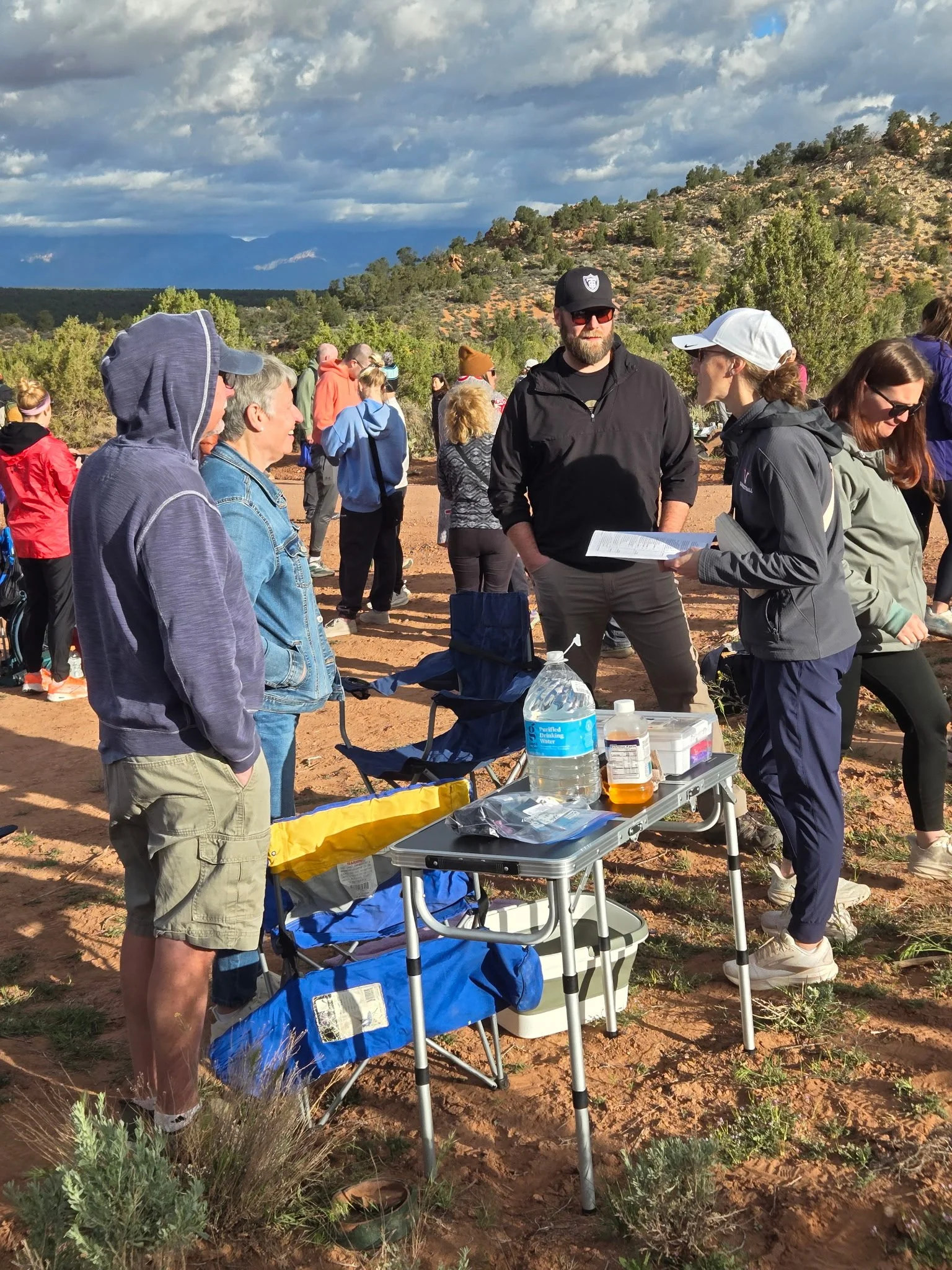
I can’t say enough about how much it means to have Amanda and my in-laws, Joel and Verlinda, supporting me.
Amanda takes her crew responsibilities extremely seriously, and I have complete confidence in her. She works as hard at doing her job well as I do running.
Joel and Verlinda have been all-in on my running as well. Crewing my first race at Zion, then driving down to help out at Javelina, and committed to helping me at the Cocodona 250 in May.
Them driving to Javelina has been a huge help, as they are bringing with all of our equipment. Tent, table, chairs, etc…
Having people willing to invest that much time and effort into something that I’m passionate about is pretty incredible.
And Amanda knows me better than anyone.
After more than 16 years of marriage, she knows which buttons to push.
Sometimes (most of the time) I’ll need a little bit of sympathy.
Other times I’ll need a swift kick in the butt and some tough love.
She is more than willing to provide either one, and she’s really good at figuring out which one is needed at a particular time.
I know my crew will be organized and prepared when I arrive, and that takes a lot of the pressure off of me.
If there is a delay at the crew stop, there’s a better chance that it is self inflicted on my part than something that went awry there.
As for Katrina, my pacer, her responsibilities are fairly straightforward, but extremely important and difficult to pull off.
Aside from having to run 20 miles herself, she has to keep me on track with nutrition, balance pushing pace while not pushing too hard, keep me efficient at aid stations, and likely listen to 4-5 hours of straight complaining.
I’m not expecting her to magically make that 20 mile segment easy, I just want her out there so she can help me do the things that I know I am capable of.
TWENTY SEGMENTS, NOT 100 MILES
Mentally, I’m not looking at this as a 100 mile race…well I am, but bear with me.
I’m planning on running 20 segments.
Aid station to aid station. Each aid station is 5% of the race completed.
I’m not going to think about how loop 5 is going to feel when I’m on loop two.
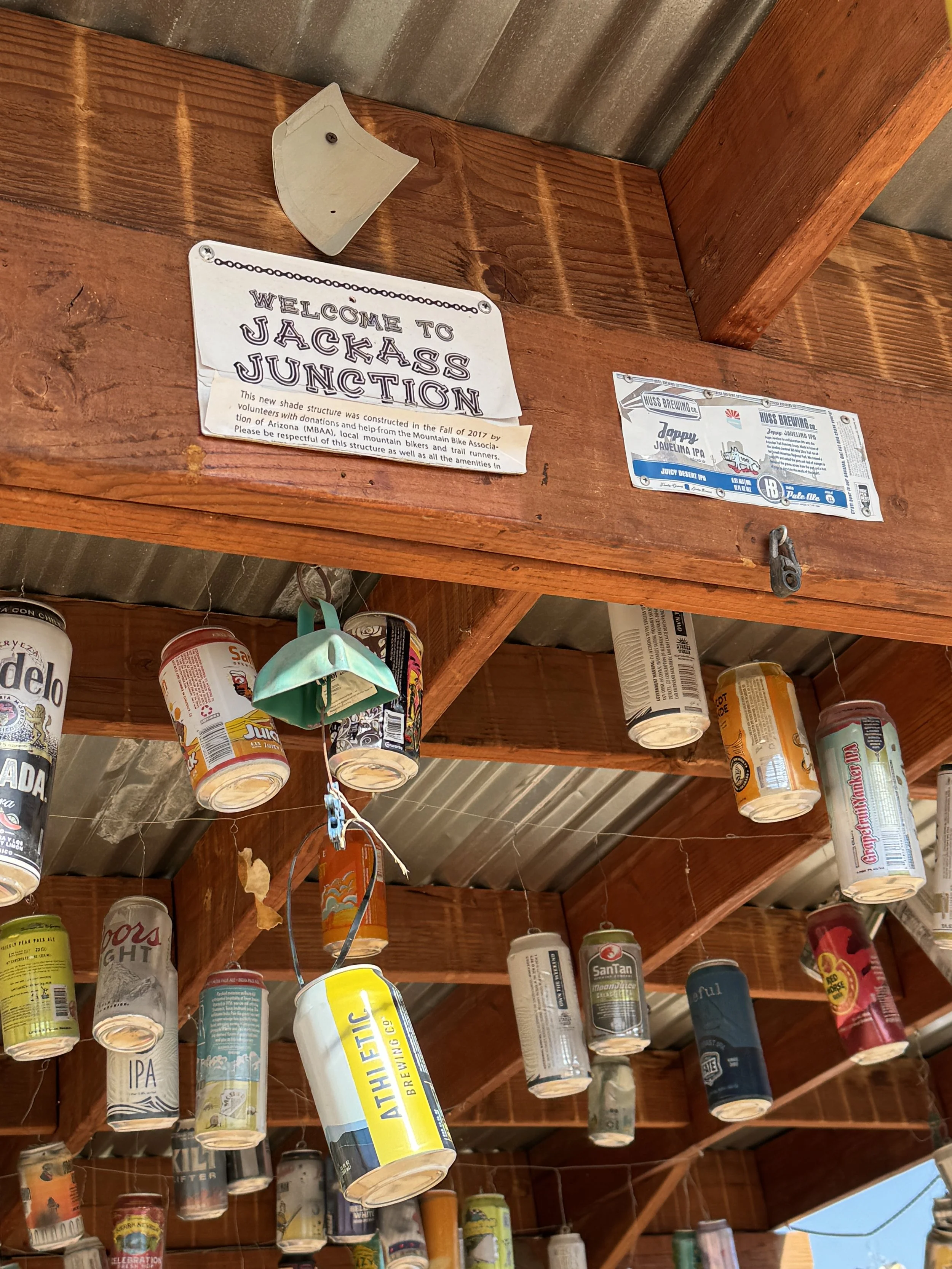
I don’t need to think about the finish line when I’m leaving Jackass Junction for the 3rd time.
I just need to get to the next aid station, check it off the list, and move on. Deliberate. Do what I am supposed to do, check it off the list, and do the next thing.
When it comes to mantras, I don’t currently have one that I plan to use, though I love quotes and mantras so that could change. Here are a few things that go through my mind:
If you can walk, you can run.
It’s supposed to be hard. That’s the point.
Constant forward movement.
It’s going to hurt now or 30 minutes from now.
Lengthen stride, maintain speed.
It almost never always gets worse.
It’s important to know going in, there are absolutely going to be stretches that suck. That is a guarantee.
But these stretches are going to suck whether I am moving fast or slow. And just because I had a terrible hour, doesn’t mean the next hour is going to be terrible as well.
A better stretch is coming, just have to keep moving so I get to experience it.
THE BIGGEST UNKNOWN ISN’T PHYSICaL
This is probably the part of the race that makes me most nervous.
I am confident that I can physically handle 100 miles in 30 hours.
I’ve run nearly 2,000 miles since January, done back-to-back 20+ mile runs numerous times, completed a couple of 30+ mile races, and have spent significant amount of time on the actual Javelina course.
I know what my body is capable of.
What I don’t know is exactly how I’ll respond mentally when things go wrong.
And something will for sure go wrong.
What happens when at mile 65 I realize that I dropped a gel, or my headphones battery died, or a cactus stabs me in the leg!
Will I be able to accept that the day isn’t going perfectly and keep moving forward?
Or will disappointment start affecting my decision-making?
That’s the unknown. And no matter how much I prepare, I won’t know how I handle that 65 miles into the race because I have never been 65 miles into a race.
WHAT GIVES ME CONFIDENCE
The biggest thing for this specific race is the fact that I have been on the course multiple times.
I’ve run approximately 80 miles on the actual Javelina course over 4 different days and two different weekends.
I know the terrain, I know what the climbs feel like, and I know the locations of the aid stations.
There’s a comfort in that familiarity that I didn’t have when I went to Zion in April.
I’ve also accumluated a lot more time on feet since Zion, including long back to back training days and races that have taught me to manage fatigue and manage effort level.
Also, finding a Physical Therapist that I have started using on a regular basis has been a game changer for me. I went into Zion with some nagging injuries that forced me to miss a big portion of my training block and with the help of my PT I have been able to consistently get in the miles needed.
If there is one thing that I wish I would have been better about, it is strength training. I lifted some in preparation for Javelina, but not as consistently as I intended, and definitely not as consistently as I will need to for Cocodona.
At the same time, I have to acknowledge the phase of life I am in. With a wife, kids, work, running, and youth sports my time is a limiting factor. Running is a priority for me, but it is not THE priority. Every hour spent lifting was an hour I couldn’t spend running.
Could I have done a better job of balancing those two? Absolutely.
But I am not going to spend the last week before Javelina playing the what if or shoulda/woulda/coulda game. I feel confident in the work I put in and I think I have put myself in a position to succeed.
THE TAPER: PROTECT THE LEGS
Right now, I’m surprisingly relaxed.
And obnoxiously excited.
My primary goal over the taper is to get to the starting line with healthy legs with a little bounce in them.
Minimal lingering fatigue. No unnecessary risks.
The one thing that does make me anxious, though, is arriving in Arizona.
Not because I’m nervous about the 100 miles, but the pre-race logisitcs.
Where is the crew tent going to be? How will that process work?
How bad is traffic going to be race morning?
Where do I pick up my big?
Where will Amanda park?
All of those little race day things that really aren’t deal breakers, always make me nervous on race morning.
Once my feet hit the trail, I think I will feel much better.
Logistics behind me, and 100 miles of trail in front.
THE FINISH LINE
I’ve thought about what it’ll feel like to finish my fist 100-mile race.
I think the first people I’ll think about are Amanda and our kids.
Amanda has supported me through this whole crazy running journey in more ways than I could possibly list. She doesn’t just tolerate the training, races, and time commitment. She’s genuinely excited to be part of it, and I love that!
And my kids are my everything.
One of the things that I hope they take away from watching me pursue these races is that a lot of things people describe as impossible aren’t actually impossible.
They’re just really hard.
And there’s a difference.
I want to be the kind of dad who demonstrates that difference through my actions. Setting big goals is only a mistake if you aren’t willing to do big work.
For me personally, finishing Javelina will also mean something pretty simple.
I’ll finally be part of the 100-mile club.
I’ve said before that signing up for a 100-mile race is easy.
Finishing one is what separates the people who have attempted it from the people who have actually done it.
I want to be on the correct side of that line.
THE OFFICIAL JAVELINA VEGAS ODDS (Maybe not official, but…)
Finish under 30 hours -400
Finish under 26 hours -110
Finish under 24 hours +220
Finishing Time Over/Under 26:35
Total Stoppage Time Over/under 130 minutes
Bathroom stops outside of a porta potty Over/Under 1.5
Precision 90 Gels Consumed OVer/Under 12
We will revisit these numbers after, and hopefully that finish under 30 hours bet pays out!
NOW WE FIND OUT
I’ve don’t the training. I’ve studied the course. I’ve built the nutrition plan, thought through pacing, and probably spent too many hours calculating how much time I can save by getting out of aid stations a little faster.
But none of that guarantees anything.
There’s still a hundred miles of desert between me and the finish line.
I’m confident in my fitness. I’m confident my crew. I’m confident that I’ve learned a ton from Zion.
What I don’t know is how this entire thing will unfold.
That’s part of what makes it interesting and fun.
I could absolutely go out and run a marathon, knowing that I can finish it, and be happy with being part of the 1% of the population that has done it.
But that isn’t the size of goal that I want to pursue, I want to pursue “you are crazy” type of goals.
The plan is to be smart early, stay consistent through the middle, handle the inevitable rough patches, and give everything that I have left over the final 20 miles.
Thirty hours is the SFL.
Twenty-six hours is what I believe I am capable of.
Twenty-four hours would be one heck of a day.
But first, I’ve got to get to the starting line.
Then, just 100 miles.