My Success/Failure Line (SFL)
I failed at Zion in April. I was only able to make it 52 miles o a 100 mile race.
I’ve said that quite a few times since April, and it’s interesting how uncomfortable that statement makes other people.
“You didn’t fail! You ran 52 miles!”
“You ran two marathons through the desert!”
“You ran the furthest you’ve ever run before!”
These are statements from well meaning people that are applauding the attempt and I appreciate them. They are supporting and encouraging me after a frustrating result.
But here’s the thing.
I didn’t go to Zion to run 52 miles. I went there to run 100.
I made it 52.
How would that be considered a success? I made it just over half way to the goal I set for myself.
If I signed up for a half marathon, ran 6.5 miles, and called it a day, I don’t think many people would be telling me that it was a success.
So why is it different when the distances get longer?
Those reactions really got me thinking about something that I’ve believed for quite a while, but only recently put a name to.
The Success/Failure Line. Or SFL
WHAT IS SFL?
It’s pretty simple really.
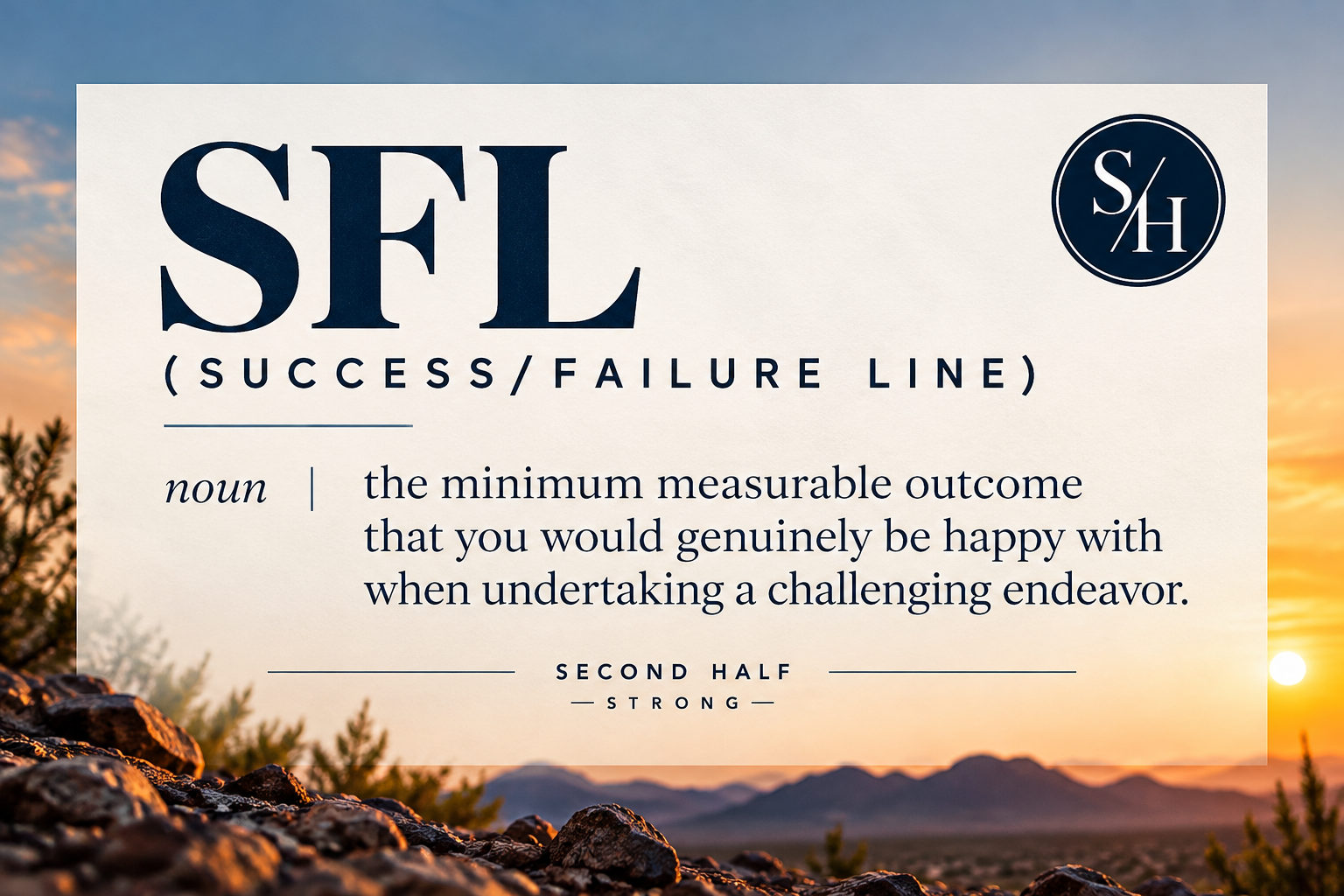
Before I start a race, I establish a clear and measurable line that separates success from failure.
Anything on the successful side of that line is a success. Anything on the opposite side is a failure.
No gray area. No moving goalposts after the fact. No changing the SFL because things didn’t go as planned.
A big part of my “job” as a runner is to ensure that things go as close to plan as possible and deal with it when they don’t. So if I miss the SFL because I didn’t nail my nutrition or I got blisters, that is still a fail because it’s my job to plan, avoid, or deal with those things when they happen.
And most importantly, it’s personal.
My SFL likely won’t be the same as yours, and yours wouldn’t be mine. And honestly, you might think the whole concept of an SFL is ridiculous which it probably is. And that is fine, we all have our own things that help get us to our goals.
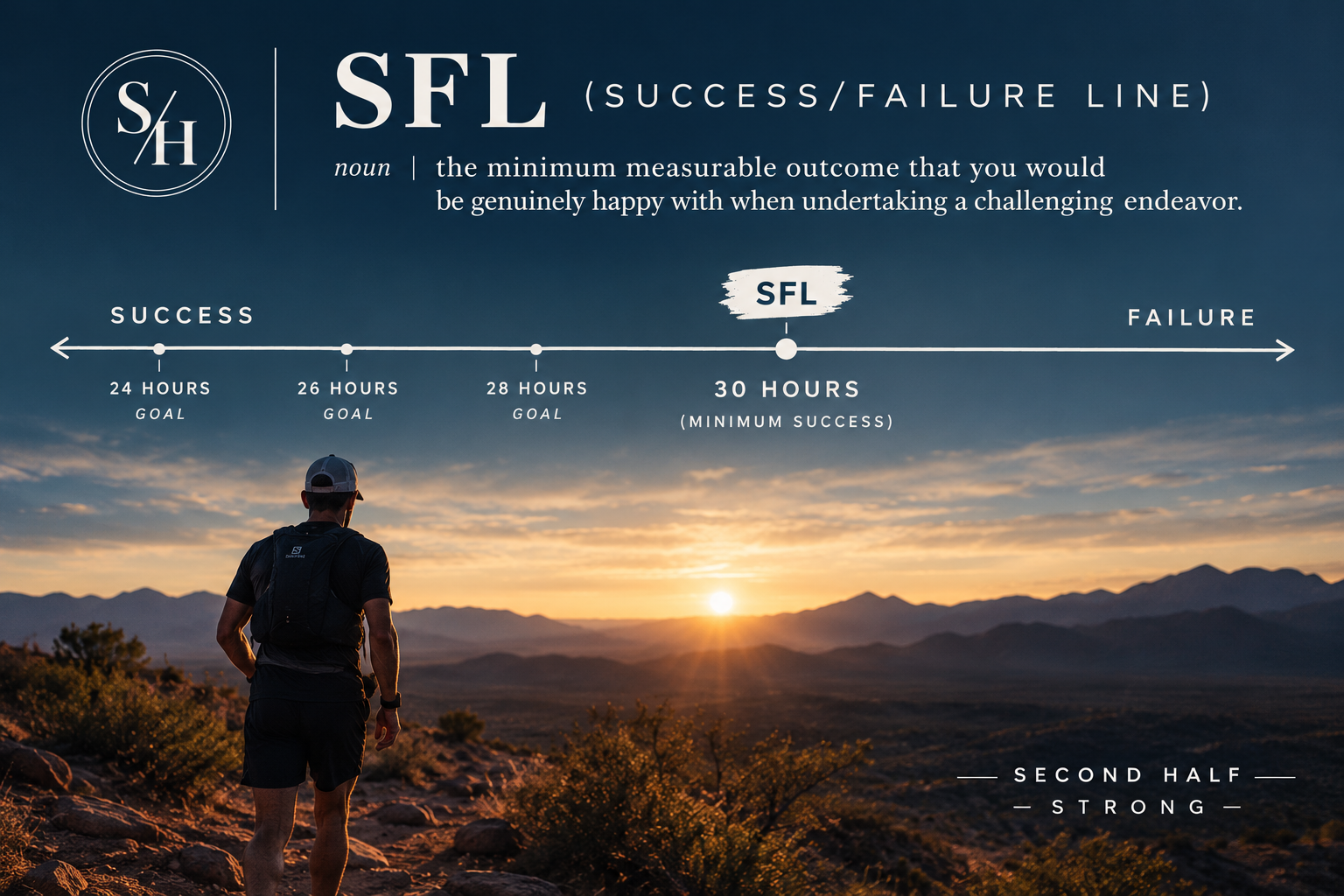
For Javelina Jundred, my SFL is 30 hours, which is also the official race cutoff.
Finish within 30 hours? Success.
Finish in 30:15:00? Failure.
DNF at mile 80? Failure.
That’s it.
Does that mean I will be equally disappointed finishing 94 miles before cutoffs as I would be if I dropped at mile 20? Of course not.
But it would still be a failure.
There’s a line for a reason.
AN “SFL” ISN’T THE SAME AS A GOAL
They are similar but not the same and there is an important distinction.
My SFL at Javelina is 30 hours, but that’s not necessarily my goal.
I’d love to finish under 26 hours. And if things go great, I think 24 hours is possible.
Those are my goals. Things that I’m shooting for.
The SFL is different because it is the minimum outcome that I would be genuinely happy with. Better than that are different goals and levels of success, and below that are different levels of failure.
So, if I think 24 hours is possible, why isn’t that my SFL?
Because I know that if I finish my first 100-mile race in 28 hours, I’ll be proud of what I accomplished. I don’t need to pretend otherwise.
The SFL isn’t supposed to be the absolute best thing that you can accomplish. It is meant to be the minimum that you would honestly consider a success.
And that line can and should change as you improve.
If I finish Javelina in 28:00:00 this year I would view that as a success according to my SFL. But if I came back next year, my SFL certainly wouldn’t be 30 hours again. I’ve proven I’m better than that. I would guess my SFL would be to improve on 28 hours.
But that’s a decision for the future.
WHY BOTHER DRAWING A LINE
Our minds are really, really good at making excuses.
Especially when things get difficult.
Let's say I’m 60 miles into Javelina. I’m exhausted, my feet hurt, I’m tired of eating gels, and the thought of running another 40 miles sounds absolutely miserable.
I can almost guarantee that my brain will start negotiating.
“You’ve already made it further than Zion.”
“Sixty miles is an incredible achievement”
“You’ve improved so much since April”
“You should be proud of getting this far”
And you know what? All of those things are true.
But none of them changes why I’m going to Javelina in the first place.
I’m going there to run 100 miles within 30 hours.
Not 60. Not further than Zion. Not until things get harder than I am comfortable with.
That’s why I want the SFL established before the race, when I’m thinking clearly and not trying to convince myself that quitting is actually a reasonable idea.
I don’t want to get to mile 60 and suddenly decide that making it further than I did at Zion qualifies as success.
Absolutely not.
That’s not what I am going for.
Of course that doesn’t mean pushing through serious injury or doing something reckless. There are always legitimate reasons to stop, and sometimes stopping is the smart decision.
But making the right decision to stop does not make the race a success.
WHAT HAPPENS IF FAILURE IS INEVITABLE
Here’s a hypothetical situation.
What if I’m at mile 75 and there’s no way that I’m going to finish within 30 hours. Do I just quit at mile 80 when I see my crew?
Why not quit if there is no chance at my arbitrary definition of success?
Because missing my SFL doesn’t mean I stop trying.
Think about a football team down 30 with 3 minutes left to play. They’re not going to win the game, but they don’t just cancel the rest of it and call it good.
They keep playing.
If I can’t finish Javelina in 30 hours I am going to get as far as I can in those 30. I owe that to myself and to the people coming with me and to the race itself. I owe it my best.
And equally as important, if I’m on pace for 24 hours and could comfortably coast in for a 28 hour finish, why not coast in? Success is success right?
Absolutely not. I still have goals beyond my SFL.
The SFL tells me whether I was successful. It doesn’t tell me when I stop pushing.
I still owe myself the best effort I have, regardless of where I am at on the SFL.
FAILURE SHOULD HURT

I think this is where people sometimes misunderstand my philosophy because it might sound like I am a bit flippant when it comes to failure.
Just because I’m comfortable acknowledging failure doesn’t mean I’m comfortable experiencing it.
Failure sucks. Failure sticks with you.
At Zion, I made some mistakes early on in the race especially on the downhills. By around mile 30-35 I already knew that I wasn’t going to be able to finish.
Think about that.
I ran (walked) another 20 miles, probably about 8 hours, knowing that failure was going to be the outcome.
Knowing I would have to tell my wife, my family, and the friends that took time out of their lives to help support me that I couldn’t accomplish what I went out there to do.
Knowing that people following me back home were going to see that I only made it half way.
It was awful. It still is an awful feeling when I think back about it.
And when I stopped at mile 52, I wasn’t immediately thinking about the valuable lessons I learned that would help me succeed at my next attempt.
I was disappointed. Frustrated. Embarassed.
I spent the next few weeks thinking about what went wrong, how I missed the mark by so much, and what I could have done differently.
Failure should absolutely burn.

I don’t think there’s anything wrong with that.
Being willing to fail doesn’t mean you have to enjoy it.
But eventually, you have to do something with it.
You have to figure out why you failed? Learn what you can. Make the appropriate changes.
And hopefully, you turn that failure into part of the reason you succeed the next time.
That’s exactly what I’m trying to do with Javelina.
FAILING DOESN’T MAKE YOU A FAILURE
I think this is where society has made the word “failure” into something much more negative than it needs to be.
People seem to almost be afraid to say it.
When I tell someone I failed at Zion, their immediate reaction is often to convince me that I didn’t.
But failing at something and being a failure are completely different things.
Just like succeeding at something and being a successful person are two different things.
I failed at Zion. But I didn’t feel like a failure as person, even in the immediate aftermath I never felt like that.
I felt like someone who attempted something difficult and didn’t accomplish it. I failed at that endeavor.
That’s all. Not dramatic. Not overly negative. Just matter of fact.
And I think the fear of being labeled a failure prevents people from attempting things where failure is a possible or even a probable outcome.
If you only attempt things that you’re certain you can accomplish, you are leaving so much on the table.
That doesn’t mean you need to go looking for failure. I certainly don’t.
I’d much rather succeed.
But I’m willing to risk failing if the thing I’m attempting matters to me.
And if I do fail, I’m willing to call it what it is. No sugar coating needed.
IT’S NOT FOR EVERYONE
I realize this philosophy probably isn’t for everybody.
If the word failure makes you cringe, the SFL might not be your thing.
And that’s perfectly fine.
I’m not suggesting everyone needs to start labeling their races, careers, or personal challenges as successes or failures.
I’m certainly not going around telling other runners that they failed because they didn’t meet some standard I invented for myself.
And when someone tells me I was successful at Zion because I ran 52 miles, I appreciate the enouragement. I say thank you and move on.
I’m not trying to win an argument over the definition of success.
This is simply how I choose to measure my own success and failure.
And the SFL doesn’t have to be complicated.
Ask yourself before a race, or whatever challenge you are taking on:
“What outcome would genuinely make me happy?”
An answer will likely come to you quick. That’s probably it. Don’t overthink it.
Just make sure that it is something that you can measure.
“Work hard”, “have fun”, “run smart”, and “do my best” are all great intentions and you should absolutely do all of them.
But how do you objectively measure them to see if you succeeded?
For me, the SFL needs to be something that I can look at afterward and know, without question what side of the line I am on.
THE LINE IS DRAWN
In a little over a week, I’ll be standing at the starting line of Javelina Jundred for my second attempt at running 100 miles.
I’ve trained hard. I’ve spent time on the course. I’ve made changes based on what happened at Zion.
And I’ve established my SFL.
Thirty hours.
I’d love 26 and would be ecstatic with 24.
I know what success looks like before I take the first step.
I don’t know whether I’ll succeed or fail at Javelina.
That’s why I’m going, that’s what makes this challenge fun.
I’ve drawn my line, I know what I am going there to do, and I’m going to give myself every opportunity to be on the correct side of the line I’ve drawn for myself.
If I do succeed, I’ll celebrate like I’m on the podium.
If I fail, it will sting. Then I will figure out what went wrong and try again. Add those lessons learned in failure to those I learned at Zion and build my toolbox of failures to make a success in the future.
Either way, I won’t have to wonder where I stood because I drew the line before I started.